
Cooling · May 14, 2026 · By Doug Kelley, Master Licensed HVAC Technician
Mini-Splits for Older Homes: A Guide for Houses That Have No Ducts
Chestertown brick from the 1700s, Odessa Federal-style, farmhouse Victorians in Ridgely, watermen's cottages in Rock Hall: the upper Shore's housing stock is a museum, and most of it predates the idea of ductwork by a century or more. For generations the options were radiators plus window units, or tearing the house apart. Ductless changed that equation completely.
Why ductless suits old houses specifically
A mini-split needs only a three inch penetration for the line set connecting the outdoor unit to each indoor head. No chases cut through original plaster, no soffits boxing in eight foot ceilings, no attic ductwork sweating onto horsehair insulation. The house stays the house. And because each head is its own zone, the system matches how old houses actually live: heat the rooms you use, let the formal parlor coast.
Beyond the wall unit
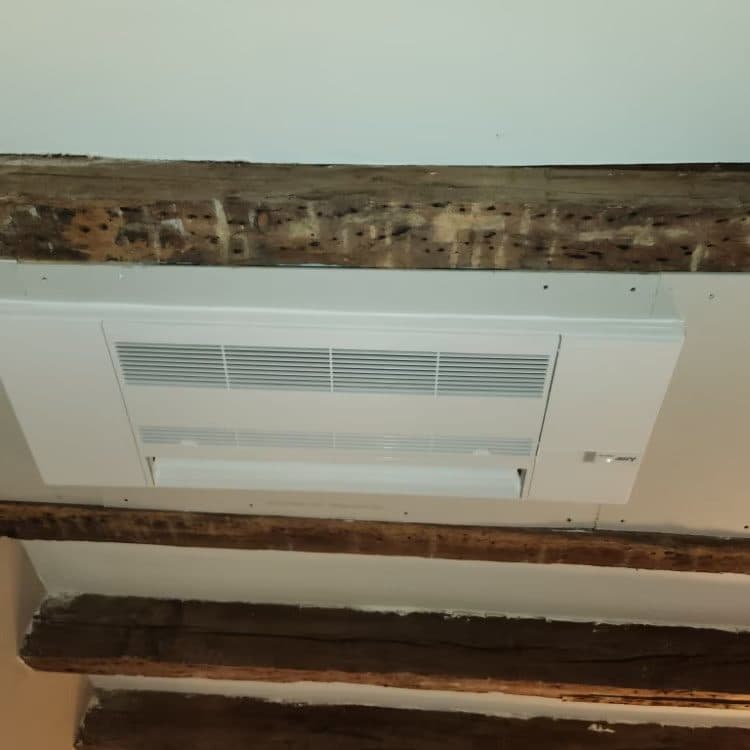
Most people picture the white wall-mounted head, and for many rooms it is the right tool. But the family is bigger. Ceiling cassettes recess flush into the ceiling, showing only a slim grille, and we have tucked them between exposed beams in houses where a wall unit would have felt wrong. Concealed-duct units hide entirely in a closet or soffit and feed two or three nearby rooms through short, invisible duct runs: ducted-style comfort in a house with no ducts. Floor-mounted units sit under windows where knee walls and low ceilings rule out everything else.
Heating too, and properly
Modern cold-climate mini-splits are heat pumps that hold their capacity deep into freezing weather, which makes them real heating for Shore winters, not just summer equipment. For old houses running fuel oil or propane through aging boilers, mini-splits often become the primary heat with the old system as backup, and the fuel bill difference is significant. The two-condenser brick rowhouse install in our photos carries both seasons on ductless alone.
What good installation looks like on an old house
Old-house ductless work rewards care: line-hide routed along trim lines so exterior runs look intentional, penetrations sealed against a masonry wall properly, condensate planned rather than dripped, heads placed for the room's real furniture, and flare connections torqued to spec so they are still tight in a decade. It is exactly the kind of detail work a small company does well and a volume installer rushes.
If you have an old house and a comfort problem, we are happy to walk it with you and talk through which of these tools fits, with honest numbers: (443) 310-0206.